মঙ্গলবার, ১৪ ফেব্রুয়ারি, ২০১৭

Climate conference 2015 in Paris

Image result for climate conference paris      Image result for climate conference paris   

Image result for climate conference paris              Image result for climate conference paris  

The slogan '1.5 Degrees' is projected on the Eiffel Tower as part of the World Climate Change Conference 2015 (COP21) on 11 December 2015 in Paris, France. Photo by Chesnot/Getty Images. 

The slogan '1.5 Degrees' is projected on the Eiffel Tower as part of the World Climate Change Conference 2015 (COP21) on 11 December 2015 in Paris, France. Photo by Getty Images. - See more at: https://www.chathamhouse.org/publication/post-paris-taking-forward-global-climate-change-deal?gclid=Cj0KEQiA8orFBRCEpODivaOft_EBEiQAy3mlfaMzhp7_SHa488xMWdq9rK__SOOxtGIJ2_uJ3iZpjeMaAqIH8P8HAQ#sthash.vfCopitM.dpuf
 

                              COP 21

The Paris climate summit, known as COP 21, took place in November-December 2015. The summit’s key objective was to agree on an international accord to keep global average temperature rise to below 2 degrees Celsius. Cities were a significant actor in this process and now are positioned to play a key role in the implementation of the Paris outcome.  


Paris Agreement
Paris Agreement under the United Nations Framework Convention on Climate Change
{{{image_alt}}}
  Parties
  Signatories
  Parties also covered by European Union ratification
  Signatories also covered by European Union ratification
Drafted 30 November – 12 December 2015
Signed 22 April 2016
Location New York
Sealed 12 December 2015
Effective 4 November 2016[1][2]
Condition Ratification/Accession by 55 UNFCCC Parties, accounting for 55% of global greenhouse gas emissions
Signatories 194[1]
Parties 131[1]
Depositary Secretary-General of the United Nations
Languages Arabic, Chinese, English, French, Russian and Spanish
Paris Agreement at Wikisource


The head of the Paris Conference, France's foreign minister Laurent Fabius, said this "ambitious and balanced" plan is a "historic turning point" in the goal of reducing global warming.[7]
One year on, the ratification of the Paris Agreement was celebrated by the Mayor of Paris Anne Hidalgo by illuminating the Eiffel Tower and the Arc de Triomphe, Paris' most iconic monuments, in green.

 The Paris deal is the world's first comprehensive climate agreement.
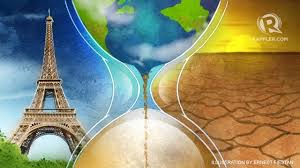
 Image result for climate conference paris    Image result for climate conference paris  


                       Image result for climate conference paris

                                           What does COP 21 stand for?
COP stands for Conference of Parties – with 'parties' meaning the countries that ratified the UN Framework Convention on Climate Change (UNFCCC) in 1992 at the Earth Summit in Rio de Janeiro.             


                                  What is Paris agreement on climate change?
The Paris Agreement (French: Accord de Paris) is an agreement within the United Nations Framework Convention on Climate Change (UNFCCC) dealing with greenhouse gases emissions mitigation, adaptation and finance starting in the year 2020.


The slogan '1.5 Degrees' is projected on the Eiffel Tower as part of the World Climate Change Conference 2015 (COP21) on 11 December 2015 in Paris, France. Photo by Getty Images. - See more at: https://www.chathamhouse.org/publication/post-paris-taking-forward-global-climate-change-deal?gclid=Cj0KEQiA8orFBRCEpODivaOft_EBEiQAy3mlfaMzhp7_SHa488xMWdq9rK__SOOxtGIJ2_uJ3iZpjeMaAqIH8P8HAQ#sthash.vfCopitM.dpuf

সোমবার, ১৩ ফেব্রুয়ারি, ২০১৭

Climate change and environment pollution

2005 was officially the hottest year in recorded history, and global temperatures are the warmest in this millennium. The ice caps and glaciers are melting even faster than expected and hurricanes have increased in strength and frequency. The evidence is in. Human activity, especially the burning of fossil fuels, is altering atmospheric chemistry.
 image   


                                            Cover image Environmental Pollution
image

A toxicokinetic-toxicodynamic model is developed to separate and measure the geochemical and physiological effects of salinity on Cu toxicity to estuarine organisms


  • image
  • Relative roles of H-atom transfer and electron transfer in the debromination of PBDEs by palladized nanoscale zerovalent iron were established.
     image   

    image  

    A lot of environmentalist persons and organizations have been concerned

    • image   
      image
    • The fate of technical chlordane and its roles as a candidate obesogen. image   


      A lot of environmentalist persons and organizations have been concerned about pollution and climate change. Climate change and global warming ha become a big issue as our nature is absolutely necessary for our existence and survival. Carbon dioxide emission from vehicles and industrial areas is the first cause of climate change and global warming.
       Image result for climate change Image result for climate change

       Image result for climate change  Image result for climate change

       Image result for climate change     Image result for climate change


রবিবার, ১২ ফেব্রুয়ারি, ২০১৭

Low carbon and greener city

Image result for low carbon and greener city      Image result for low carbon and greener city  

Image result for low carbon and greener city  Image result for low carbon and greener cityImage result for low carbon and greener city         

Image result for low carbon and greener city                     Image result for low carbon and greener city     
Image result for low carbon and greener city       Image result for low carbon and greener city                                      

                                              What is a low carbon city?
It is a city that comprises of societies that consume sustainable green technology and emit relatively low carbon as compared with present day practice to avoid adverse impacts of climate change.  


Image result for low carbon and greener city      Image result for low carbon and greener city       Did you know
Climate change is a natural process that occurs over time. Before the industrial age, climate change was an effect of changes in solar energy, volcanic eruptions and natural changes in greenhouse gas concentrations. However since the mid-20th century, it has been established that increased human activities is the cause for rising temperatures and climate changes.


 Image result for low carbon and greener city   Image result for low carbon and greener city     

                                       
                                              Image result for low carbon and greener city
                  Image result for low carbon and greener city               


শনিবার, ১১ ফেব্রুয়ারি, ২০১৭

Global Warming & Air Pollution


Global Warming Causes

Global warming is primarily a problem of too much carbon dioxide (CO2) in the atmosphere—which acts as a blanket, trapping heat and warming the planet. As we burn fossil fuels like coal, oil and natural gas for energy or cut down and burn forests to create pastures and plantations, carbon accumulates and overloads our atmosphere. Certain waste management and agricultural practices aggravate the problem by releasing other potent global warming gases, such as methane and nitrous oxide. See the pie chart for a breakdown of heat-trapping global warming emissions by economic sector.  

Global Warming Emissions by Economic Sector

Global Warming Emissions by Economic Sector
Source: IPCC Fourth Assessment Report: Climate Change 2007, Working Group III: Mitigation of Climate Change, Chapter 1. This is a snapshot of emissions in 2004
 Take Action Now! Why You Need to Act Now
Substantial scientific evidence indicates that an increase in the global average temperature of more than 2°F above where we are today poses severe risks to natural systems and human health and well-being. To avoid this level of warming, the U.S. needs to reduce heat-trapping emissions by at least 80 percent below 2000 levels by 2050. Delay in taking such action will require much sharper cuts later, which would likely be more difficult and costly.
Factories' Pollution & Other Causes of Global Warming 

বুধবার, ৮ ফেব্রুয়ারি, ২০১৭